


SkinChronicles, No 11, March 2026, by Haruna Kimura
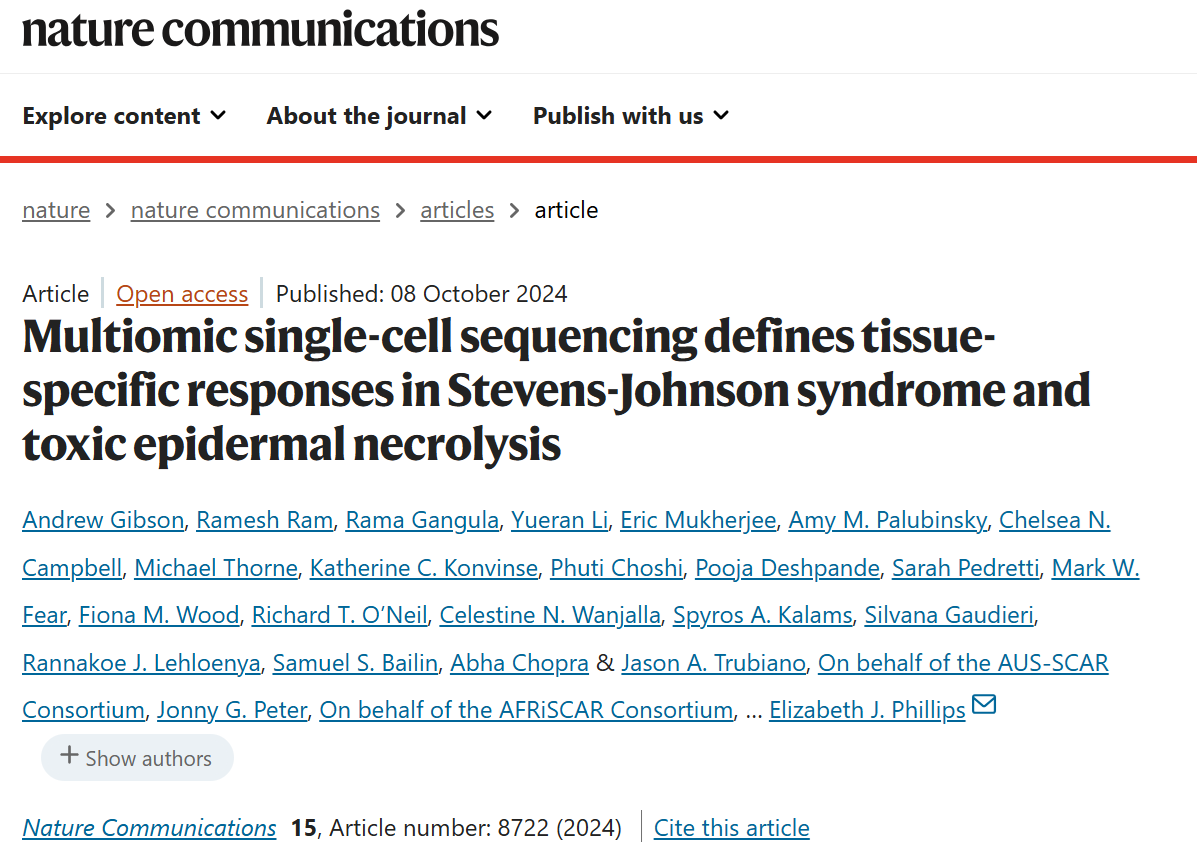
Stevens-Johnson syndrome/toxic epidermal necrolysis (SJS/TEN) is a rare, severe cutaneous adverse reaction characterized by extensive keratinocyte death and epidermal detachment, yet the lesion-level immune circuitry remains difficult to define. Gibson et al. conducted an integrated multi-omic analysis combining single-cell transcriptomics, surface proteomics, and T-cell receptor (TCR) sequencing of unaffected skin, lesional skin, and blister fluid from 15 patients with SJS/TEN. They found that lesional keratinocytes upregulated interferon-linked transcriptional programs and markers indicative of enhanced HLA class I antigen presentation. Lesional tissue was enriched for CD8+ T cells exhibiting a robust cytotoxic signature, including granulysin, granzyme B, perforin, along with features of tissue-resident memory T cells (CD103/ITGAE, CD49a/ITGA1, CD69). Notably, private clonally expanded TCRαβ sequences were preferentially enriched in affected skin but were absent or not expanded in unaffected tissue, supporting a localized, antigen-driven immune response. Complementing these findings, Chen et al. provide an upstream mechanistic perspective in immune checkpoint inhibitor-induced SJS/TEN, demonstrating that macrophage-derived CXCL10 recruits CXCR3+ cytotoxic T cells. Ex vivo blockade further implicates TNF signaling in disease propagation, and clinical observations are consistent with more rapid recovery in patients treated with TNF inhibitors.
IMPORTANCE TO THE FIELD: These studies represent a milestone, moving beyond descriptive inflammation toward a cell- and clonotype-resolved framework that links keratinocyte programs, resident cytotoxic CD8+ T cell states, and actionable recruitment and signaling axes.
IMPORTANCE TO MY RESEARCH: As a physician-scientist studying SJS/TEN pathogenesis and therapeutic strategies, I find the clonotype-level resolution particularly enabling. These atlases motivate me to leverage expanded TCR sequences as testable drug-HLA-peptide hypotheses and as biopsy-based readouts to determine whether candidate interventions reduce clonal expansion and keratinocyte-cytotoxic programs, thereby informing target prioritization and clinical trial endpoints.
LINKS:
1. Gibson A, Ram R, Gangula R, Li Y, Mukherjee E, Palubinsky AM, Campbell CN, Thorne M, Konvinse KC, Choshi P, Deshpande P, Pedretti S, Fear MW, Wood FM, O’Neil RT, Wanjalla CN, Kalams SA, Gaudieri S, Lehloenya RJ, Bailin SS, Chopra A, Trubiano JA; AUS-SCAR Consortium; Peter JG; AFRiSCAR Consortium; Mallal SA, Phillips EJ. Multiomic single-cell sequencing defines tissue-specific responses in Stevens-Johnson syndrome and toxic epidermal necrolysis. Nat Commun 15, 8722 (2024). https://doi.org/10.1038/s41467-024-52990-3
2. Chen CB, Hung SI, Chang JW, Yang CK, Ma DH, Teng YC, Lu CW, Chen WT, Yang HY, Tsai CC, Wang CL, Chiang PH, Wu J, Tsai YW, Lu LY, Lin YY, Hui RC, Hsieh FM, Hsu CK, Lee CN, Chen YJ, Chen CC, Cui Y, Hsu HC, Chang YC, Chang CJ, Lin HC, Chang CJ, Lin YJ, Ku CL, Wang CW, Chung WH. Immune checkpoint inhibitor-induced severe epidermal necrolysis mediated by macrophage-derived CXCL10 and abated by TNF blockade. Nat Commun 15, 10733 (2024). https://doi.org/10.1038/s41467-024-54180-7

Division of Dermatology, Niigata University Graduate School of Medical and Dental Sciences, Niigata, Japan.
