


SkinChronicles, No 12, April 2026, by April Rose Foster
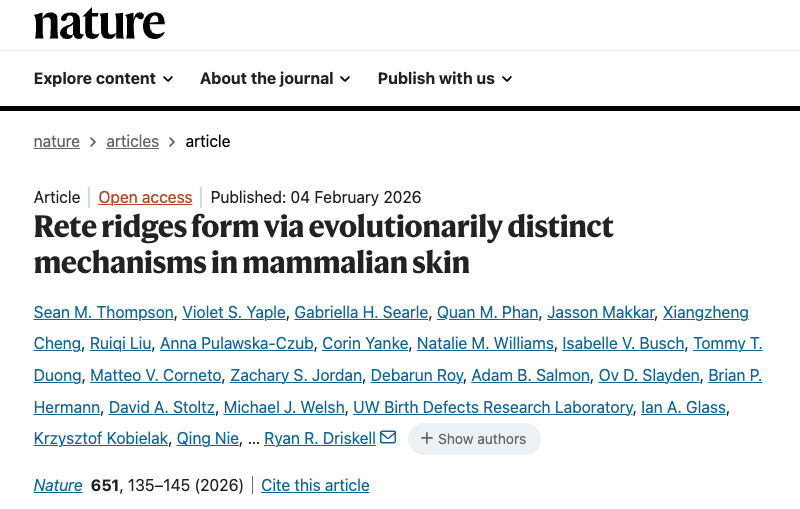
A fascinating new publication from the Driskell lab led by Sean Thompson et al brings two key ideas: i) a distinct molecular mechanism in the development of rete ridge network driven by BMP signalling and ii) challenges the way we approach choosing the “best” model in our efforts to answer key research questions.
Thompson et al, highlight the rete ridges as a key appendage of the skin that provides important structural integrity through increased surface area and anchoring that provides an essential barrier for the human body to the harsh external environment. The rete ridges are an often-under-appreciated skin appendage that also provide an essential therapeutic opportunity in tissue regeneration.
Beyond the importance of rete ridges, Thompson et al also offers a novel view of potential model organisms applicable for skin research. A question we often ask ourselves in dermatological research; what is the “best” model available to be able to answer my question or hypothesis?
In recent years we have seen revolutionary efforts across the field in developing complex models from 3D skin equivalents and ex vivo skin organ culture to the induced pluripotent stem cell derived organoid model (Lee et al, 2020 Nature and 2022 Nature protocols), all of which have enhanced the opportunities in developmental and translational dermatological research. Thompson et al present another view on this highlighting the relevance of mammalian models available. Here, they present a breadth of skin samples across the animal kingdom from dolphins to grizzly bears. You may be surprised to find out that in the context of the rete ridge network and its development, human skin is most closely related to the mangalisa pig or the grizzly bear, providing a novel view on how to select our research models.
Using the pig skin, the group asked the question of when and how rete ridges develop? In human prenatal skin, it has been shown that rete ridges are not observed up to 17 PCW, unlike the development of other skin appendages such as the hair follicle and eccrine glands (Gopee et al, 2024). Using prenatal and neonatal pig skin, Thompson et al demonstrate that rete ridge development occurs postnatally around ten days. This would be a somewhat difficult human sample set to obtain. In summary, this new publication exploring the valleys of the skin, provides a distinct molecular mechanism in their development and an alternative view on research models used in dermatological research.
Highlighted paper: Thompson, S.M., Yaple, V.S., Searle, G.H. et al. Rete ridges form via evolutionarily distinct mechanisms in mammalian skin. Nature 651, 135–145 (2026). https://doi.org/10.1038/s41586-025-10055-5

Senior Staff Scientist, Haniffa Lab, Wellcome Sanger Institute
