


SkinChronicles, No 14, June 2026, by Agata Lichawska-Cieślar
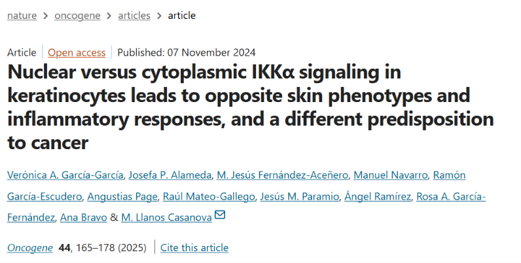
The study on IKKα localization in keratinocytes demonstrates that the subcellular distribution of this kinase plays a critical role in the development of cutaneous squamous cell carcinoma (cSCC). IKKα, a key component of the NF-κB signaling pathway, exhibits distinct functions depending on whether it is localized in the nucleus or in the cytoplasm. Nuclear IKKα is associated with the regulation of gene expression programs involved in keratinocyte differentiation, aging and development of cSCC. In contrast, its exclusive cytoplasmic localization leads to enhanced inflammatory signaling, increased cellular proliferation, and inhibition of cSCC. These findings highlight that IKKα is not only a regulator of inflammation but also a critical determinant of the balance between keratinocyte proliferation and differentiation, and for the malignant transformation in the skin.
Importance in the field
This work provides important insights into the molecular mechanisms underlying skin carcinogenesis, particularly in the context of inflammatory signaling and tumor development. By demonstrating that IKKα can exert tumor-suppressive or tumor-promoting functions depending on its localization, the study expands our understanding of NF-κB signaling as a highly context-dependent pathway. These findings also suggest that targeting protein localization or trafficking could represent a novel therapeutic strategy in SCC and potentially other epithelial cancers.
Importance to my research
This study is highly relevant to my research, which focuses on the regulation of inflammation in the skin and cSCC development. The findings emphasize that inflammatory signaling is regulated not only at the transcriptional level but also through post-translational and spatial mechanisms, such as protein localization. The study provides a strong conceptual framework for investigating how dysregulation of signaling components may contribute to chronic inflammatory skin diseases and cancer. It also supports the idea that alterations in regulatory mechanisms upstream or downstream of NF-κB could have significant effects on disease progression, which aligns closely with the objectives of my research.
Source publication
García-García VA, Alameda JP, Fernández-Aceñero MJ, Navarro M, García-Escudero R, Page A, Mateo-Gallego R, Paramio JM, Ramírez Á, García-Fernández RA, Bravo A, Casanova ML. Nuclear versus cytoplasmic IKKα signaling in keratinocytes leads to opposite skin phenotypes and inflammatory responses, and a different predisposition to cancer. Oncogene. 2025 Feb;44(3):165-178. doi: 10.1038/s41388-024-03203-0. Epub 2024 Nov 7. PMID: 39511409; PMCID: PMC11725495.

Postdoctoral Researcher
Jagiellonian University, Department of Biochemistry, Biophysics and Biotechnology